
December 26, 1944
Not your typical Christmas story

My father was taken to a German concentration camp in German-occupied Austria, at the age of 9, in May of 1944. Due to a curious deal, it was not a death camp. This is his memory of one day.
by Thomas J Kertesz
The guard slowly walked by on the narrow trail. A fresh dusting of snow under his boots made a creaky sound. He was an older man, older than my father; but younger than my grandfather. The yellow lapel tabs of his uniform showed he was a Luftwaffe ground support soldier. By this time in the war they drafted, at least for non-combat duty, anyone who could stand and walk. I was watching him from the other side of the fence.
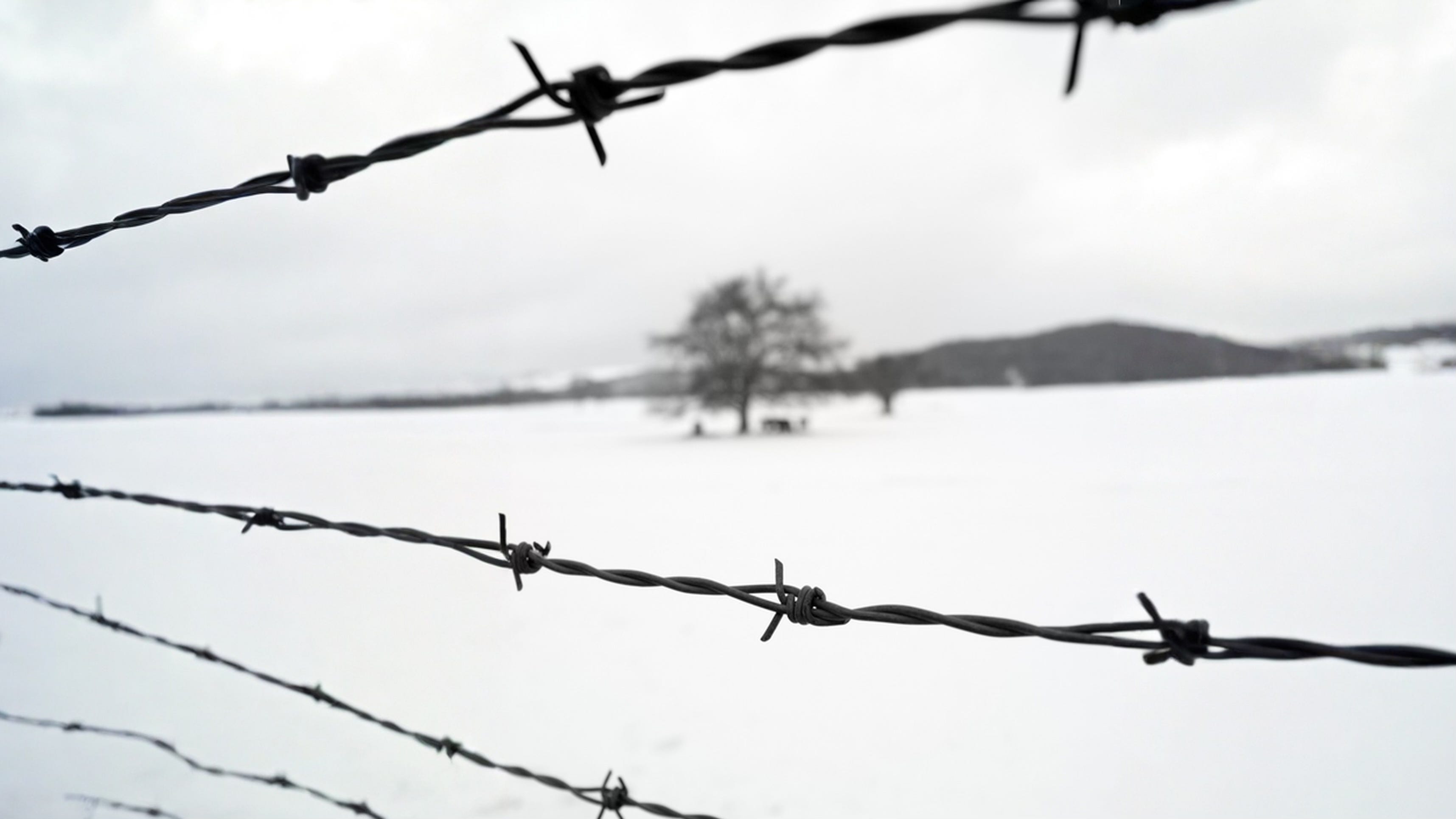
The barbed wire separating us always reminded me of the staff lines of sheet music from my piano lessons. Those lines were straight; these sagged, despite the cold weather. The guard marched down the length of the fence, turned right at the corner and walked halfway down the other side, where he turned around and reversed his course.
When he turned right at the corner, I pushed the two bottom wires apart, slipped through the fence and disappeared into the forest beyond. It was a familiar routine. I don’t think the guards were too concerned. They knew we had to come back. Where would sub-teen Jewish boys go in 1944’s Germany?
I walked along the trail until I cleared the forest and stood in the furrows of a well-plowed field. I was looking for an access road to the field which obviously belonged to someone. The camp was close to Deutsch Wagram, a small hamlet in the vicinity of Vienna. The area was a mixture of well-tended farmlands and campgrounds, favored by the Viennese Hitlerjugend. I walked a little way, trying to make sure I don’t run into anyone, when suddenly a voice rang out: “Wohin spazierst Du?”
Where are you strolling?
He was an older man, obviously exempted from military service to perform work critical to the Reich. Food is important. There was a hoe on his shoulder, he looked friendly. He sized me up quickly. He saw the yellow star and undoubtedly knew that I was from the camp.
“Ich hoffe, ein paar Zuckerrüben zu finden,” I answered
I hope to find a few sugar beets.
“It is too late in the season to find them”, he responded, still in German. “Those left behind are rotten.”
He gazed at me with a pensive look for a while. I was motionless. I didn’t know what to do. I couldn’t run away and I was afraid to move forward. I felt I was stuck. I had frequently gotten out of camp in the past, but never alone. I was with children of similar age. I think there was a 13-year-old amongst us. He was the oldest. We actually never encountered adult Germans. We ran into teenagers and the so-called “free French” laborers, who lived in a nearby camp and worked in factories, railroad yards and farms in this area, north of Vienna.
“Komm mit mir.”
Come with me.
“Vielleicht finden wir einen Ersatz.”
Maybe we find a substitute.
This began to look complicated. I couldn’t run away. He could take me back to camp. The danger with that outcome was not the guards or their noncommissioned officers, who were generally kind and just trying to get through all this alive. It was the camp commander, rumored to be a former elementary school teacher. She was full of hate and constantly threatening to kill all Jews. So I decided to follow him. Least dangerous option. He did look kind.
We got further and further away from the camp and headed toward a farmhouse. It was obviously his home. We entered the gated yard. A few chickens were scraping the hardened dirt and I heard the sound of one or two pigs from the sties in the back of the house. We entered the house. It was warm and you could smell the slightly acrid odor of the soft, brown coal burning in the fire place.
There was a small Christmas tree on the dining room table. No Christmas candy to decorate the branches, just the burned-out remnants of a few sparklers.
“Bitte setz dich.” the man said, turning toward me.
Please sit down
I sat, and in a moment a gorgeous slice of walnut cake was placed in front of me, followed by a glass of milk. I had not seen or tasted milk since early June, and saw no cake of any kind for at least a year. I just looked at this slice of miracle, with walnut pieces embedded in the cake and walnut icing on top. Maybe things are going to get better after all and we will get back home soon. I will see my father again. Who will be waiting for us. I drank the milk, but could not touch the cake. I was afraid that if I touched it, it might disappear.
Then the enticement became too much and I cut into it with my host’s kitchen knife.
It didn’t take long for me to finish it. “Vielen Dank. Ich bin sehr dankbar.”
Thank you. I am very grateful.
He led me back to the trail. We said good-bye, and I headed back to the camp.
—
The author is deeply grateful to Festi and Hans Weitekamper for editing the German text.
—
Editor’s note:
Of the three trains that took Jews out of Kalocsa in 1944, two took their passengers to death camps. My father’s train, however, was diverted to Austria. About 18,000 Hungarian Jews were kept “on ice” as the Nazis hoped to trade their lives for resources to support their failing Eastern Front. My father was detained near Deutsch-Wagram outside Vienna. Conditions were harsh but unusual; adolescent boys could slip out of the camp to play.
My father drew his own lesson from that winter, one that remains with me today: even among strangers—and even in dark times—there are good people.
—
This is lovely. The moment when the boy is afraid to challenge the miracle of the walnut cake is so moving. Hope is precarious, but trust in the good — and hunger! — overcomes. If it’s not an overstated analogy, I’d like to hold this story as a sign that the many people in pain and distress in our country at this time can and will be meaningfully helped by the many good people around us. We will get through this time. ❤️ Thanks for sharing this, Stefan.
I love this story!